SETUP GUIDE
Everyone has to start somewhere, and the games industry can often make it hard to find out exactly where to go. Passion in creative fields can go a long way, but knowing the industry, refining skills, and preparing a solid foundation is what gets you across the finish line. In the Egg section of our resources, we teach you the beginning from the ground up. What does a games industry resume look like? Where should I be uploading my portfolio? What’s the name of the career title I’m hoping to pursue? There are so many questions that can seem like steep mountains for beginners, and we’re here to help you hatch.
00: GETTING STARTED
So, let’s begin by fully starting with the fact that I am a game artist. There will be other paths that you will be able to take depending on your role, and we’ll get into that as we explore further, but for now, let’s take a look at getting into the game dev scene from the standpoint of my role. Most recently, I worked as a paid intern for a company called SoupCorp Games as one of their artists. I snagged the role about a year after committing fully to finding a job in the industry, and it serves as my first paid role for a fully-formed studio. While I did not have an art majors or degrees, I did work by commission for freelance work for several years while in school and participated in over 8 game jams (more on that later) and did work for several indie studios as volunteer work as well. This was ESSENTIAL in landing my position and creating my portfolio.
The very first thing is don’t quit your day job. The game industry is highly sought after and unless you have been signed onto a stable full-time position, don’t quit your job to focus on making games. Discipline is important and you should be tackling the game dev growth cycle in your free or off-time (though make sure you have time for your own wellbeing, too). I worked and continue to work in non-game design fields while also working an in-industry job for the stability of pay, especially in the current market. Do create a LinkedIn. We’ll talk about how this is set up in later chapters, but LinkedIn is THE growth network for the game industry outside of actual in-person meets, and even then remains on top. I completely remade mine following leaving my previous employer so I could focus specifically on what I wanted. The current market for the game industry is difficult, even for seasoned professionals. Stay optimistic, but do recognize that this might not be a potential full-time source of income right off the bat. That being said, indie studios and passionate creators have more ways in and more resources than ever, and I believe they truly are paving the way for the industry as a whole.
01: PERSONAL SETUP
Unlike many other forms of job hunting, your presence and activity online is often crucial with connecting to other game industry pros and highlighting your current and past works in the form of a portfolio. As an artist, the key links are Artstation and LinkedIn, which are vital for communication and portfolio work.
Outside of that, I had several links and resources to my works and presence in the space. I had an Itch.io account that featured all of my game jams that were playable, so people could see that I had experience making games under short deadlines and creating assets that could actually BE used in a game. My Twitter and BlueSky served as a way for me to post constant updates in a more relaxed manner. A continuous pitfall of new game dev hopefuls is that they post every piece of artwork, when they should only be highlighting a few.
Some creators also make their own website which can be useful, but I have been informed by high-up pros through conference Q&A that Artstation really is the best way to go.
LinkedIn, as mentioned before, is your number one go to. Because it is so vital we speak about it, we’ll do another post purely devoted to the development of your LinkedIn page. For now, know that you must have your FIRST AND LAST NAME, a photo of yourself, and (if you are entering a role that requires it) a link right at the top of the page. You can post routinely and you should, but these things are vital for recruiters checking out your profile from the get-go.
ARTSTATION
Artstation, as mentioned before, is a portfolio specifically for artists. It is the very first thing people are going to look for if you are applying into that role, and as such should be clean, easy to navigate, and minimalistic/not overcrowded. It should also feature your finished work with process attached as well. Similarly to LinkedIn, this is a whole chapter on its own, so we’ll talk more in depth on the subject later. Know for now you’ll need your name, current and past artworks, and start-to-finish processes of single pieces to showcase your workflow.
02: LINKEDIN A-Z
Mentioned in our previous post, LinkedIn is king when it comes to this industry. It’s going to be where you interact with most folks in the industry, and it’s going to be where you post most of your content outside of a portfolio space. It is important to be, for better or worse, constantly posting and updating with something.
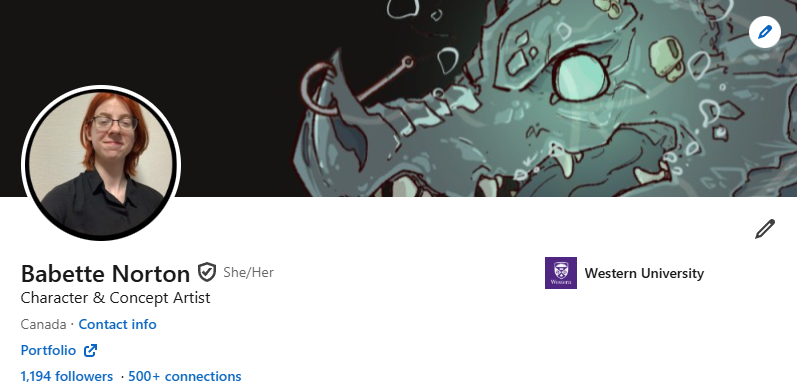
In the example above, we can take a look at how my current LinkedIn is formatted to be accessible to people hiring. Very first rule: DON’T BE AFRAID TO USE THE BANNERS. Open to work banners let recruiters and networkers right away you’re looking for work, even if you are currently employed; your contract may be coming to an end or may be part-time, allowing for more work. You’ll notice there isn’t a lot here. That’s important. Here is some of the key things on this profile:
- - Full name (No usernames here! This is for professional name use) and optional pronouns
- - A professional and up-to-date headshot of yourself that is friendly but business-approachable. You don’t need to be in a blazer, but it shouldn’t be a tank top.
- - A banner photo, which is typically for artists a piece they’re proud of.
- - Your subtitle & roles (more on this later)
- - Portfolio link, especially if you’re an artist. Make sure it works on mobile!
- - Location, especially if you’re looking for non-remote work
- - Graduate information so people know your education status
YOUR SUBTITLE AND ROLE

People often have a problem creating their subtitle and roles in a concise way. You should absolutely not have more than one line, and you should make sure right away people can see your role (IE: What you’re looking for). ESPECIALLY in art, you need to keep this specific and concise, unless you are choosing to write “Generalist” (which especially on it’s own is not recommended).
Highlight exactly what kind of art you do. “Artist” isn’t going to cut it. Are you a 2D artist? a 3D Character artist? Environmental? Concept? Do you do QA work, or are you a game designer? Levels? As you can see, things get a bit complicated. I recommend searching up titles of roles in the industry and selecting the one or two that best suit you.
ADVERTISEMENT
In the past, I have also included generalist as I work in a variety of fields, but my main focus is character & concept work at this time.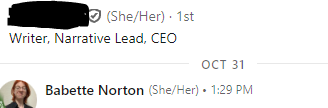
If you follow these rules, your name and title will be easy to read in messaging, which often determines heavily if people want to accept your message & connection requests.
ABOUT YOU
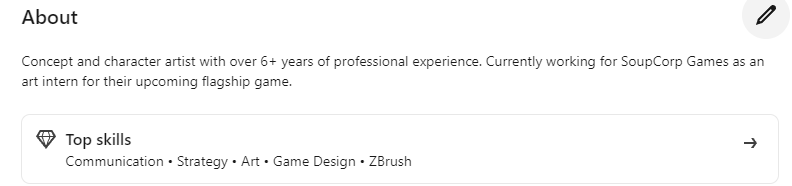
About you can just be a general set of information, and you should be choosing top skills relevant to your role (I focus on art and 3D modelling materials as well as inter and intrapersonal skillsets).
FEATURED POSTS
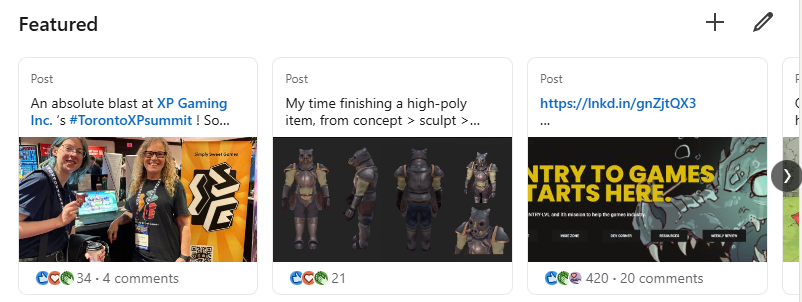
Featured posts can be highlighted on your profile page if there are specific things you want people to see, as posts on LinkedIn are very collapsed when being normally viewed. You want to catch peoples’ eyes right away, and this is a great way to do it. I choose typically to highlight an upcoming steam release or studio I worked with, events I've attended, and/or updates to ENTRY LVL.
EXPERIENCE
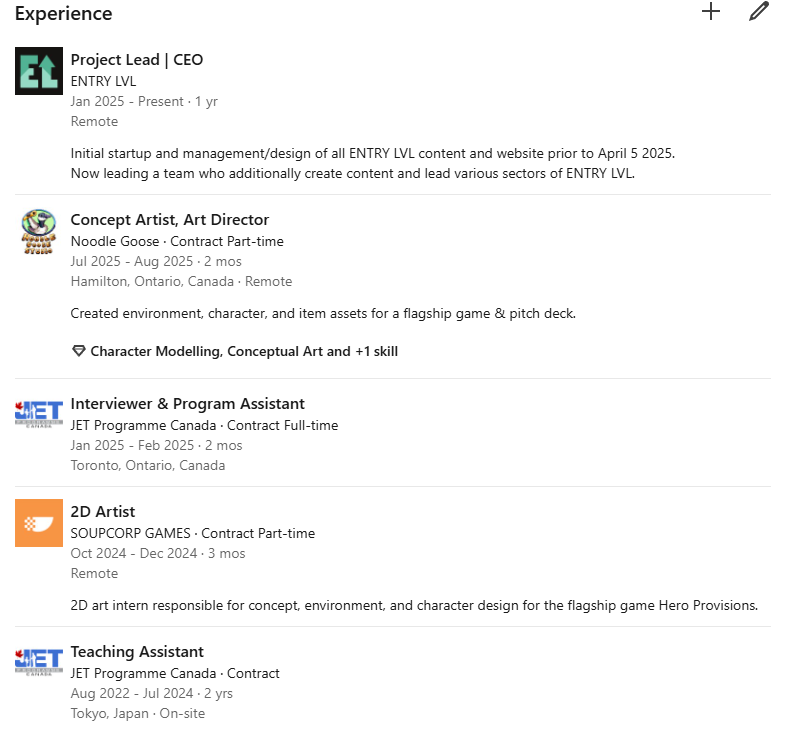
Experience is where you highlight the things you have done that make you a notable hire. You shouldn’t include every single thing you’ve ever done in your life, but you should cover recent past jobs, especially the ones that are relevant to the roles that you’re applying to. While you may not have any professional experience specifically, you can also feature volunteer work or adjacent tasks.
At the end of the day, you should have a clean and professional account that is easy to navigate if you are letting people explore your portfolio or other links. Good luck, and happy networking!
03: PORTFOLIO LOOKS
WHERE TO PUT YOUR PORTFOLIO
Nowadays, most companies will do their portfolio requirements via a link to your portfolio. This isn’t ideal if you’ve formatted it like a PDF, so today we’re going to go over some of the best ways to make a portfolio. So, how do we set up a good portfolio website? The first thing to look at is the website itself. Having your own website is great and extremely customizable, but it can be very costly in the long run to keep going (especially if you’re already short on funds!). Website-builders such as Wix and Weebly fill this problem, but even then it can take extra money and even not quite be built for portfolio managing.
When I had the amazing opportunity to attend Montreal’s Game Summit in 2024, I asked an outsourcing team member of Riot Games a question that was important to my job search: homemade website or hosting site? Her answer was simple: Artstation (a professional portfolio hosting site) was the way to go. And even better for us, Artstation is 100% free to use and can allow us to follow, comment, and connect with other artists.

Artstation.com requires little setup and looks clean and extremely professional. Many industry-known talents upload their contributions to games from indie to AAA here.
SETTING UP YOUR ARTSTATION
The first thing you’ll need to do is create an account. This will require a username that becomes a portion of your link. Some folks use their online artist alias and some use their full name. I use my online alias of Knightsicle but also ensured to include my professional name I’m known by as it appears in both the title and header of your page. Since my linkedin has my photo, I use a simple logo/icon here. You can also customize a header at 2660px x 1140px minimum to add some fun to your page.
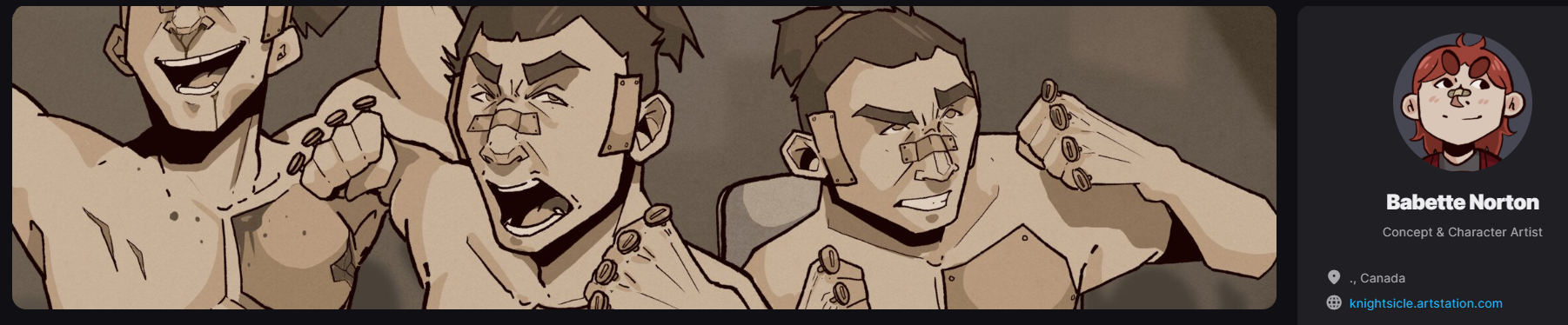
Keep your information short: what do you do, where you work, and a small bio are great. The highlight here is your portfolio.
It’s recommended to keep the amount of portfolio pieces short and varied (around 5 pieces), but I have also had success with 6-12. Currently, I have 12 varied pieces on my Artstation account ranging from 3D to environments. That being said, I truly recommend you stick to the kind of thing you are highlighting to what you’re applying for. You may love an environment piece but be a character artist; these things wouldn’t appeal to character art applications necessarily.
WHAT PIECES SHOULD YOU INCLUDE?
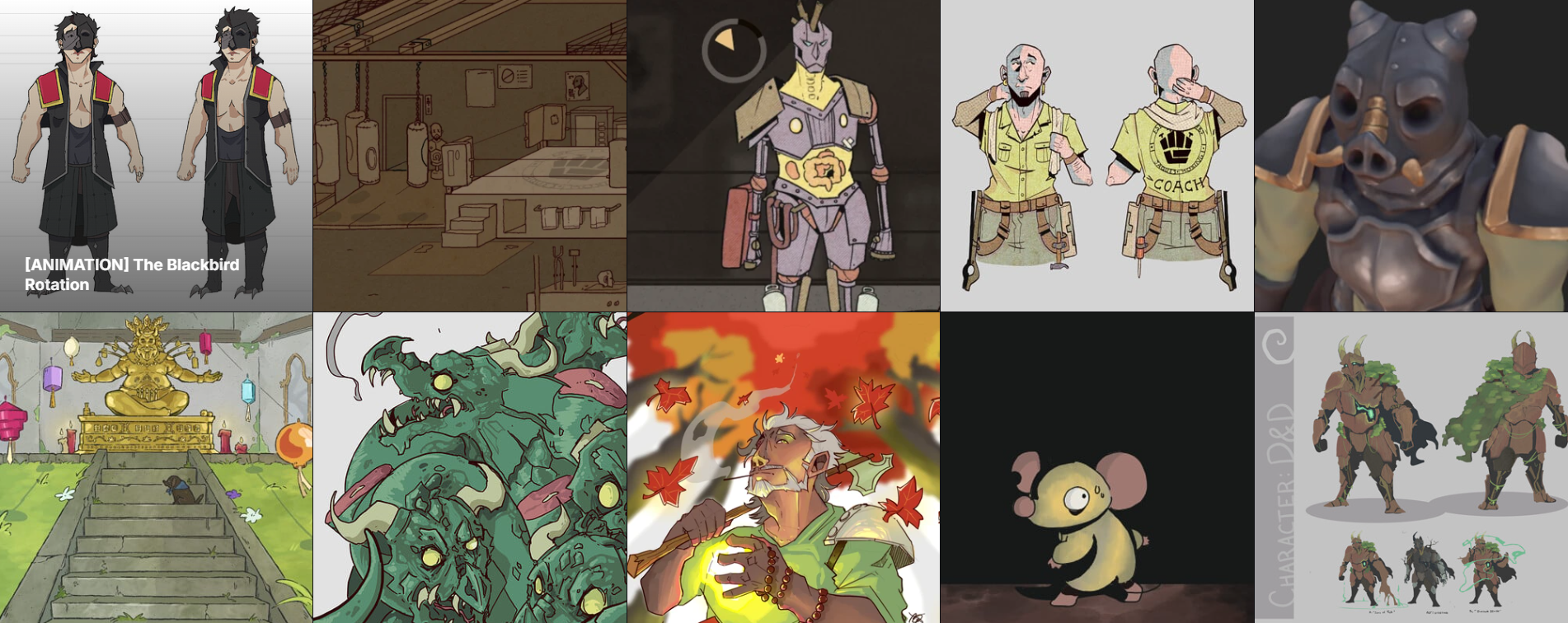
Of course, you should only be including works that you are proud of and ones that are relevant to the fields that you are applying to. I focus on character and concept art, so the majority of my pieces fall under that umbrella. Each portfolio piece will have a customizable thumbnail: this should be the best and finished shot of your product. WIPs are not welcome here, save it for social media! For 3D art especially you should show that you can do all the steps of design from start to finish; professionals state that most companies are looking for someone who can do it all: Sculpt, UV-wrap, Texture, Colour…all of it.
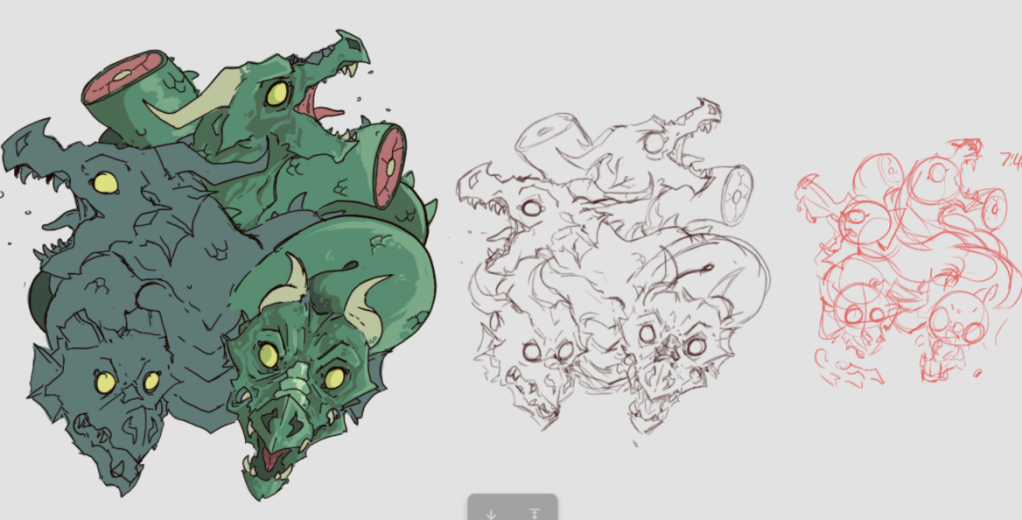
Another piece of advice professionals in the industry have given me is that you should always describe and show your workflow. Here’s a great breakdown:
FOR 2D ART :
- Final piece at the top
- Use of the piece in-game if applicable
- WIP sketches (see below)
- Revisions
- Greyscales/early colour
- Extra content
FOR 3D ART :
- Final piece at the top
- Use of the piece in-game if applicable
- WIP sketches (see below)
- Revisions
- Greyscales/early colour
- Extra content
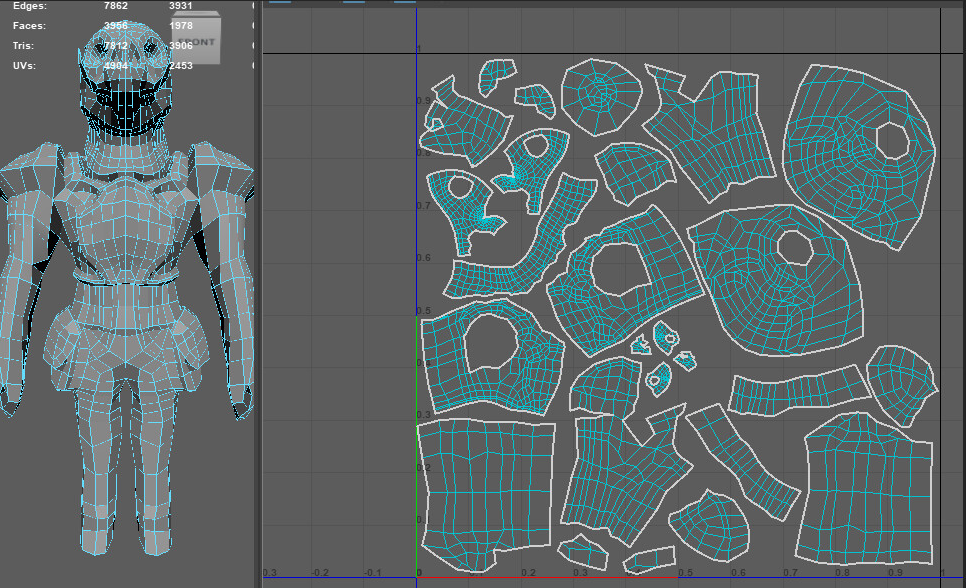
In addition to this, you should have all of your information accompanied by a brief blurb of text explaining what you are doing and how it’s important. You can add this text directly in artstation while uploading your piece. Finally, be sure to give your piece a nice title that explains exactly what it is! Below, I’m including the step-by-step information for my piece Asonides Boss Card [Doodle Deities]:
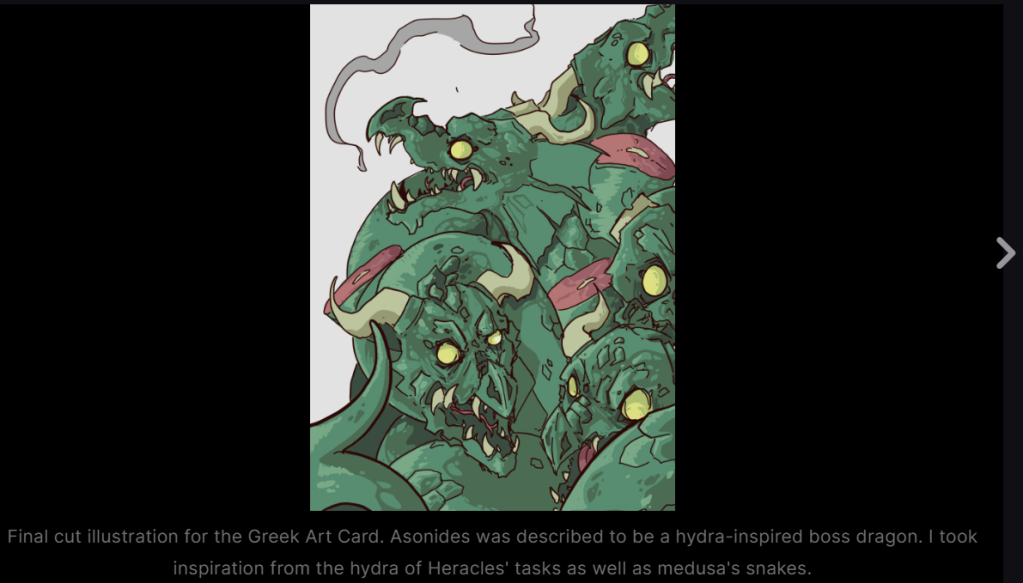
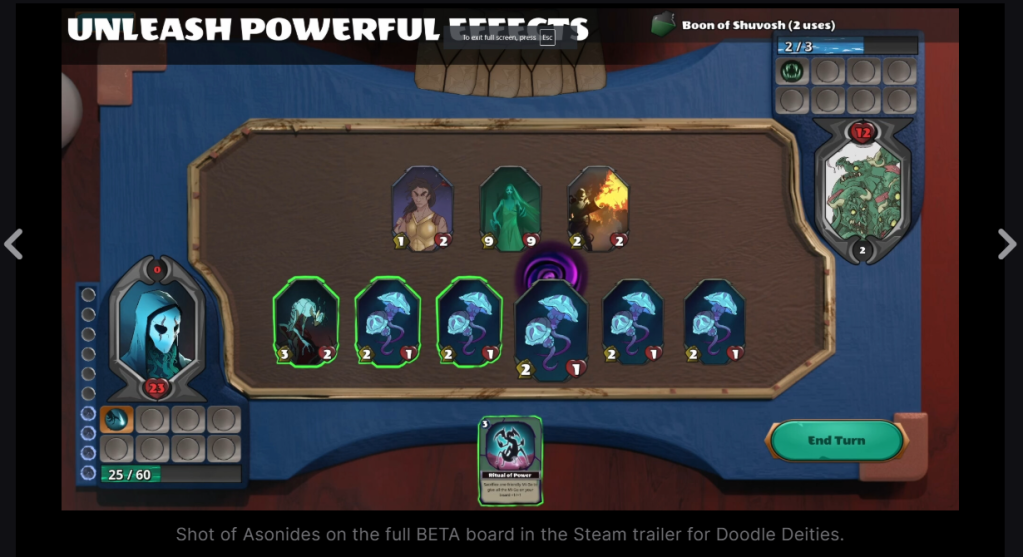
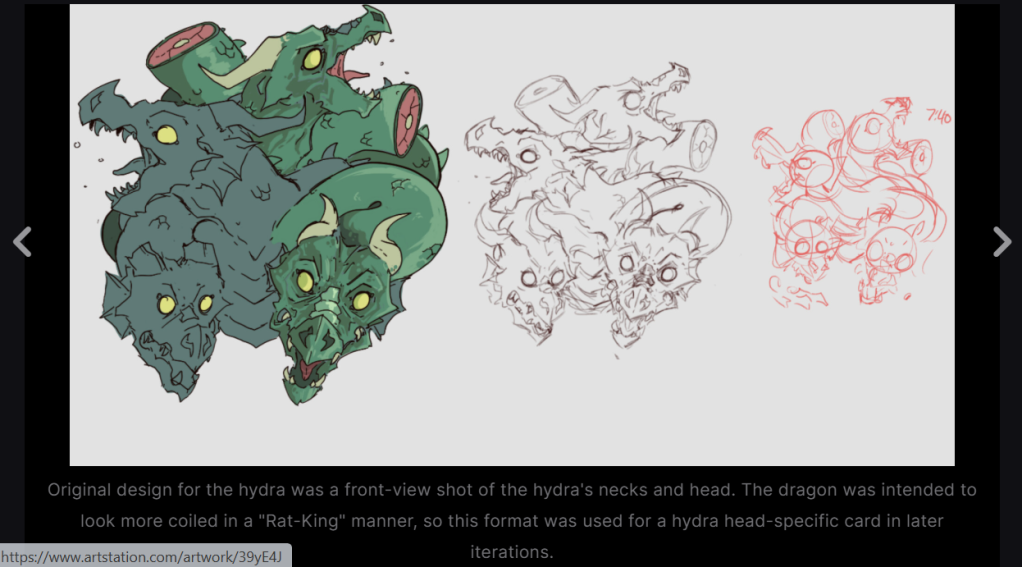
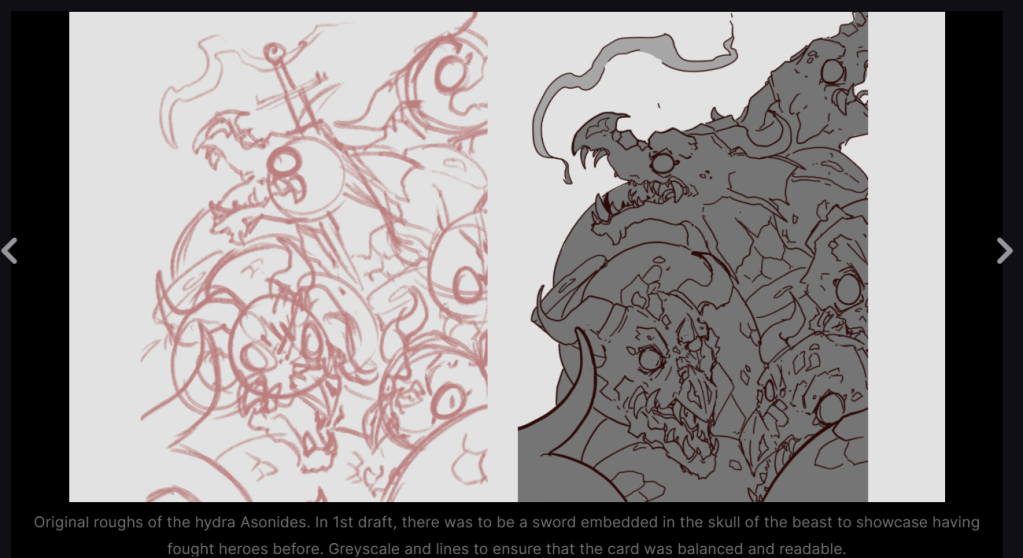
It is also important to point out your specific work if it is not clear or you didn’t do all of the illustrations shown! I have additionally listed that I “only completed the card illustration and the rest was completed by other studio team members“.
FINAL TOUCHES
It’s always good to upload your portfolio regularly, including pieces that are now with updated skillsets or challenging your range of ability. Your portfolio shouldn’t for example be all one character, all one animal, or all one style. Show the people looking at your application FAST what you can do. For the arts, portfolios are the main thing you need to showcase. Let’s make sure it represents you as best as possible! Good luck, and happy portfolio-ing!
04: NETWORKING BASICS
NETWORKING BASICS
“The action or process of interacting with others to exchange
information and develop professional or social contacts.”
-Oxford Languages
Networking is an essential part in helping you establish a career, and this idea is especially important for the games industry and other creative fields. Networking will help you connect with professionals above and below your experience level, provide advice for your future, and let you get in touch with hiring processors.
While I won’t be delving into it too deeply, discord can also be an amazing way to network as can game jams. We’re going to talk about the benefits of these more in different articles, so stay tuned!
WHAT NETWORKING ISN'T
Networking does not mean if you cold call enough people on LinkedIn you will be hired. As Amir Satvat has stated before (but paraphrased), networking should be about connecting with peers and meeting new colleagues and friends in the industry, and this may end up blossoming into connection opportunities.
This is important. Ultimately, you should be networking to meet people in your field, not to get you a job. And I’ll explain a bit further: network beyond your exact field and obtain so many more learning opportunities. If you only send connection requests to 2D artists when you’re a 2D artist that’s fine, but you have the ability to learn from and connect with so many more people when you broaden that to simply “people in games”.
THE DREADED CONNECTION REQUEST
Requesting to connect to strangers is difficult. You’ll likely be doing the majority of this on LinkedIn, and there if you don’t have a premium account you’ll be limited to a certain number of personalized connection requests each month. I would recommend following these steps:
- - If new, get your 1 month free of LinkedIn Premium
- - Send personalized message requests (more on that later) to people
- - If you don’t have personalized requests, commenting on a post to signal you’ve sent a connection request in response to a post is often better than a cold call When all else fails, cold connect!
PERSONALIZED CONNECTION REQUESTS
Connection requests are accompanied by a small blurb of words that you can add to your invitation to connect on LinkedIn. You should be including some key things, including:
- - Your name and how/if you directly know the person
- - What you do
- - Why you want to connect
You have a limited amount of words, so be sure to keep it short and sweet. The person receiving the request will also see only the start of the message and the title you choose, so make sure it gets your point across! Like I said in our LinkedIn setup page, make sure your profile includes a very short inclusion of what you do so people can see at an immediate glance:
CONNECTING IN PERSON
Connecting in-person can be done in a million different ways. Most commonly are small community gaming events and game conferences. During conferences, bringing a business card is amazing as it will include all your information, and you can ask for the other persons’!
The most important thing is being your authentic self. Don’t talk to people to get hired. Talk to people because you like games. Even if you’re nervous, it is critical to attempt to reach out, as otherwise new folks in the industry are likely to not know anyone in particular at events and thus vice versa.
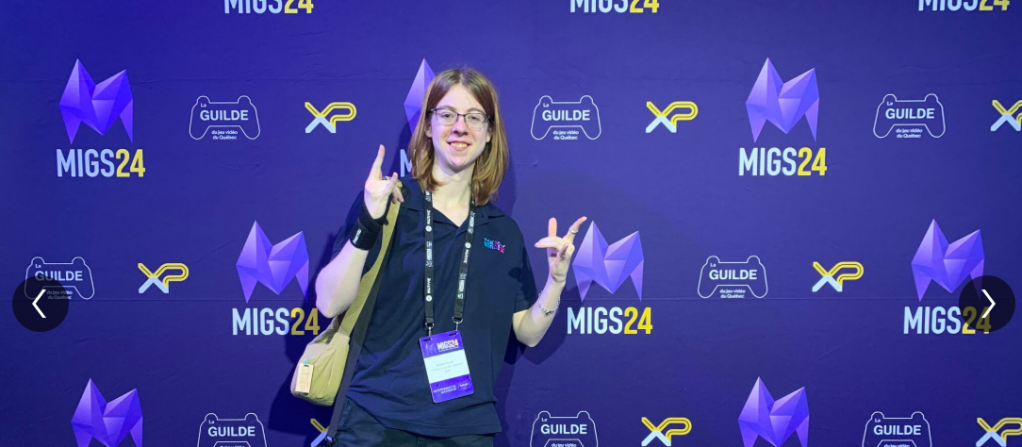
Be nice, have fun, and enjoy your community!
05: ROLES & TITLES
THERE'S HUNDREDS OF GAME INDUSTRY ROLES...
The games industry relies a lot on networking and reaching out, especially on LinkedIn and social media sites. Often times, this and your resume should have a simple title that describes your current role (or role you’re seeking) in the industry.
A big issue that many individuals fall into is the trap of not understanding roles properly. something too broad like “artist” is no good; what kind of artist are you? 2D? 3D? VFX? Something that doesn’t match actual common role titles is no good either.
This fantastic link by CREATIVE ASSEMBLY is similar to what I utilized when I was first searching for roles. While I did dabble a bit in 3D art and was able to put it in my resume, my main focus was character and concept art in the 2D space. Concept art is far different from illustrations, so I had to break concept and character art separately; I’ve made both ready-for-game 2D art assets and concept page sheets for environment and characters. One of the biggest pieces of advice that is consistently given is to NARROW DOWN TO YOUR SPECIFIC ROLE. Personally, I like to list 2, max 3, roles at a time. Currently I’m listed as a character and concept artist. The rest of the details can be broken down further on my resume. Yes, I am comfortable with environment, but it’s not my main focus. I do speak enough languages to translate and do QA work, but my LinkedIn focuses specifically on that.
For RESUMES, always make sure that your title reflects the job you are applying for. It’s a bit contradictory to what I said before, I know. But if you’re applying to a translation position despite being mainly an artist, it’s important that your resume is tailored to the job, and that will include focusing on the fact that for this role, you’re a translator (and so forth).
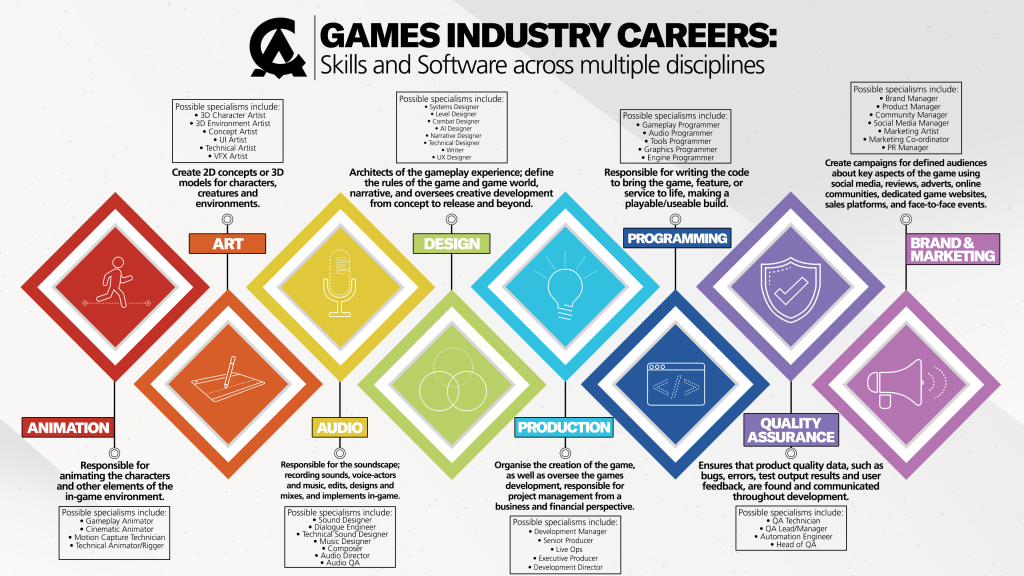
CREATIVE ASSEMBLY‘s fantastic image showcasing large roles of the industry.
NOW, WHAT ABOUT GENERALISTS?
I’m sorry to not be able to give a nice clean answer on this one. Some professionals swear that focusing on a specific role is the way to go, as it demonstrates that you are focused and rapidly increasing your craft (as explained to me by a AAA 3D artist from amazon). Some also say that generalism is the way to go, as it proves that you can accomplish multiple roles and are thus able to fill multiple shoes for one salary. In general, I personally find that focusing on a role is fantastic for AA or AAA titles and large studios, and that mentioning you’re a generalist or familiar with other aspects of the pipeline is good for small and indie studios. Regardless, if you are a generalist you should still be tailoring yourself to the role at hand and highlighting your strongest roles.
06: VOLUNTEERING
Volunteering can be a dicey thing, especially when you’re doing work you’d traditionally be paid for. The unfortunate news is while you always deserve to be paid for your work, volunteering free services may be a fantastic way to initially break into the sector of games you want to be in and stand out from a crowd.
Especially with development, there are many different spaces for volunteering your time; most notably, individuals will look for programmers, writers, or sound producers/composers to collaborate with them. Again most notably these positions are based on revenue-share models, promising a cut of the money earned at the end of the day.
I did volunteer work in games as a concept and illustrator artist for several games following 5 or so game jam events. My work allowed me to constantly pump out illustrations I was proud to advertise, and also add my name to a shipped title (which many junior role individuals do not have).
WHAT TO LOOK OUT FOR
Volunteering can also be a way to exploit labour, especially out of entry level positions and for the idea of “exposure” – a dreaded word many of us have heard before. Generally, my experience-based advice is this:
- - DO NOT prioritize volunteer work over paid gigs. Your time is money, and that should reflect what you are doing.
- - DO NOT ALLOW FULL-TIME WORK EXPECTATIONS. You are a volunteer and should be treated as such; a 40 hour work week is not a justifiable workload for someone doing pro-bono work.
- - ALWAYS ASK to see a GDD or current model. Many “Idea Men” are seen consistently on websites like INAT and Discord. We’ll talk about this more below.
- - ALWAYS ASK for a revenue breakdown and NEVER EXPECT to make money from a revshare project. Revshare products very rarely make up the cost of time of creation, and when they do (and are properly divided) you’re often looking at dollars, at most.
- - DO ASK the calendar plan. If you are not the project lead, seeing a time-based breakdown of a project ensures that everyone is working on task and has clear goals.
"IDEA MEN" AND VALUING YOUR OWN WORK
“Idea Men” are in the hundreds and populate many volunteer servers. They have great ideas, but otherwise contribute no technical skills to a project and source that from others. The problem is, everyone has great ideas. It’s properly creating them and formatting them that is what stops everyone from making their own video game.
When you’re doing volunteer work and viewing websites, be wary of “largescale ideas”. Most typically, this is beginner studios or solo devs claiming to want to make “an MMO” (of any kind – these are notoriously hard and insanely expensive) or largescale projects with a tiny team.
GOOD SOURCES FOR VOLUNTEER WORK
Websites like LinkedIn, Reddit’s INAT, and Discord servers with reputable sources are all good places to find volunteer work. Look for a studio and use the advice above to ensure that you are getting valued for your time, and remember that you are able to back out of a project if you need to.
GAME JAMS
Game jams can be a great way to dip your toes into studios. Small projects with a time limit allows you to find a team and understand workload breakdowns, while also having something to show. Before joining any studio, I did around 6 game jams (primarily as an artist and occasionally writer). itch.io has a great page for finding them!
SO IS VOLUNTEERING THE WAY TO GO?
At the end of the day, you should be valuing your art and also recognizing that volunteer projects demand a lot of time that you need to be willing to contribute as part of a team. Volunteer work can look fantastic on a resume when done right, so best of luck!
07: CREATING A STUDIO
So, let’s begin by fully starting with the fact that I am a game artist. There will be other paths that you will be able to take depending on your role, and we’ll get into that as we explore further, but for now, let’s take a look at getting into the game dev scene from the standpoint of my role. Most recently, I worked as a paid intern for a company called SoupCorp Games as one of their artists. I snagged the role about a year after committing fully to finding a job in the industry, and it serves as my first paid role for a fully-formed studio. While I did not have an art majors or degrees, I did work by commission for freelance work for several years while in school and participated in over 8 game jams (more on that later) and did work for several indie studios as volunteer work as well. This was ESSENTIAL in landing my position and creating my portfolio.
The very first thing is don’t quit your day job. The game industry is highly sought after and unless you have been signed onto a stable full-time position, don’t quit your job to focus on making games. Discipline is important and you should be tackling the game dev growth cycle in your free or off-time (though make sure you have time for your own wellbeing, too). I worked and continue to work in non-game design fields while also working an in-industry job for the stability of pay, especially in the current market. Do create a LinkedIn. We’ll talk about how this is set up in later chapters, but LinkedIn is THE growth network for the game industry outside of actual in-person meets, and even then remains on top. I completely remade mine following leaving my previous employer so I could focus specifically on what I wanted. The current market for the game industry is difficult, even for seasoned professionals. Stay optimistic, but do recognize that this might not be a potential full-time source of income right off the bat. That being said, indie studios and passionate creators have more ways in and more resources than ever, and I believe they truly are paving the way for the industry as a whole.
08: ATTENDING EVENTS
So, let’s begin by fully starting with the fact that I am a game artist. There will be other paths that you will be able to take depending on your role, and we’ll get into that as we explore further, but for now, let’s take a look at getting into the game dev scene from the standpoint of my role. Most recently, I worked as a paid intern for a company called SoupCorp Games as one of their artists. I snagged the role about a year after committing fully to finding a job in the industry, and it serves as my first paid role for a fully-formed studio. While I did not have an art majors or degrees, I did work by commission for freelance work for several years while in school and participated in over 8 game jams (more on that later) and did work for several indie studios as volunteer work as well. This was ESSENTIAL in landing my position and creating my portfolio.
The very first thing is don’t quit your day job. The game industry is highly sought after and unless you have been signed onto a stable full-time position, don’t quit your job to focus on making games. Discipline is important and you should be tackling the game dev growth cycle in your free or off-time (though make sure you have time for your own wellbeing, too). I worked and continue to work in non-game design fields while also working an in-industry job for the stability of pay, especially in the current market. Do create a LinkedIn. We’ll talk about how this is set up in later chapters, but LinkedIn is THE growth network for the game industry outside of actual in-person meets, and even then remains on top. I completely remade mine following leaving my previous employer so I could focus specifically on what I wanted. The current market for the game industry is difficult, even for seasoned professionals. Stay optimistic, but do recognize that this might not be a potential full-time source of income right off the bat. That being said, indie studios and passionate creators have more ways in and more resources than ever, and I believe they truly are paving the way for the industry as a whole.